DHI vs FUE: Which Hair Transplant is Best for You?
Home / FUE Hair Transplant / DHI vs FUE: Which Hair Transplant is Best for You?
Updated On : January 27, 2026 | Category : FUE Hair Transplant | Author: Beverly Hills Hair Restoration Team
Hair transplants have become a trusted solution for long-term hair restoration, and the comparison of FUE vs DHI is one of the most searched topics today. Both methods are modern, minimally invasive, and designed to deliver natural results. However, when looking to dhi vs fue, the main differences lie in how hair follicles are implanted and how density is achieved. Understanding fue vs dhi hair transplant options helps patients choose the technique that best matches their hair loss pattern, expectations, and recovery goals.
Difference between DHI and FUE
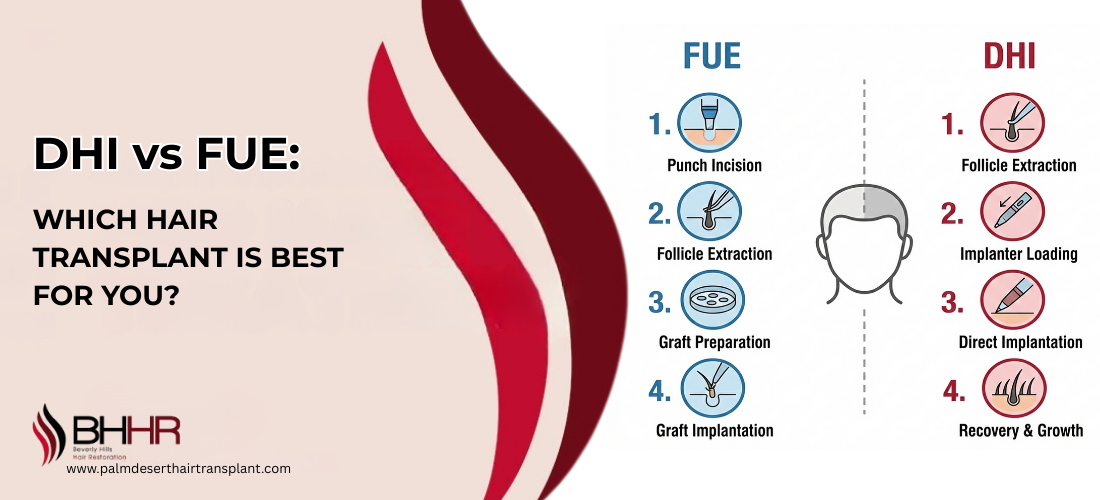
The main difference between FUE and DHI lies in the way hair follicles are implanted. In the fue hair transplant method, FUE includes extracting individual follicles from the donor area and then implanting them into small, pre-made incisions on the scalp. This two-step process allows surgeons to work efficiently, especially when treating larger areas of hair loss.
DHI uses a specialized implant pen that places each follicle directly into the scalp in a single step. This reduces the time grafts spend outside the body and gives the surgeon more control over depth, angle, and direction. Both techniques can deliver natural-looking, long-lasting results when performed by experienced professionals.
DHI vs FUE Hair Transplant: Side-by-Side Comparison
Understanding the differences in both DHI and FUE hair transplant procedures can enable you to select the best among them that fits your hair type, hair restoration needs, as well as your daily routine. While considering dhi vs fue hair transplants, the procedure of hair implantation, precision, and recovery become crucial.
The comparison chart below highlights the main differences in the fue vs dhi hair transplant process, from surgical technique and graft handling to healing time and overall results, making it easier to decide which approach may be right for you.
|
Comparison Factor |
DHI (Direct Hair Implantation) |
FUE (Follicular Unit Extraction) |
|
Procedure |
Uses a Choi implanter pen to implant grafts directly without creating pre-made channels |
Hair follicles are extracted and then manually implanted into pre-created recipient sites |
|
Cost |
Higher due to advanced tools |
More affordable, especially for |
|
Success Rate |
Around 80-85% when performed by an experienced clinic with proper aftercare |
Typically 85-90%, depending on surgeon skill and graft handling |
|
Scarring |
Minimal to no visible scarring; suitable for short hairstyles |
Tiny dot scars may be visible with very close shaving |
|
Tools Used |
Choi implanter pen for precise, direct placement |
Micro-punch tools, forceps, and sapphire blades in Sapphire FUE |
|
Implantation Method |
One-step process combining incision and implantation |
Two-step process: channel creation followed by graft placement |
|
Precision Level |
Higher precision allows for dense and natural-looking hairlines |
Good precision, though slightly less control over angle and direction |
|
Best Suited For |
small-area refinement |
Large coverage areas such as the crown or full scalp |
|
Grafts Per Session |
Lower volume, usually 1,500–2,500 grafts per session |
Higher volume, often 3,000–4,000+ grafts in one session |
|
Surgery Duration |
Longer due to detailed and precise placement |
Shorter for high-volume graft procedures |
FUE vs DHI Hair Transplant: A Closer Look at How Each Method Works
To make the correct choice between the appropriate hair transplantation procedures, it is very important to grasp the differences between FUE and DHI hair transplantation. Both of these procedures have been highly successful, but the main difference between them lies in the way hairs are implanted, the duration of recovery, or the desired outcomes of these procedures. The breakdown below takes a closer look at fue vs dhi hair transplant options to help you decide which technique aligns best with your hair restoration goals.
DHI vs FUE Hair Transplant Procedure
DHI uses a Choi implant pen that allows precise placement, making it suitable for small, detailed areas. However, fue procedures are often preferred because FUE offers greater flexibility, higher graft counts, and more consistent coverage. By implanting follicles into pre-made channels, FUE works especially well for larger balding areas and delivers reliable, natural-looking results for a wider range of patients.
DHI vs FUE Cost
DHI usually incurs higher costs owing to the time-consuming procedure, the use of implanter instruments, and the direct implantation method. It is commonly performed for critical procedures, such as delicate hairstyles. Fue hair transplants, on the other hand, tend to be cost-effective, most importantly in the case of extensive procedures. This makes fue cost effective and more practical choice for long-term hair restoration.
FUE vs DHI Hair Transplant Success Rate
When comparing dhi vs fue results, DHI may show a slightly higher graft survival rate because follicles spend less time outside the body and undergo minimal handling. The use of a Choi implanter pen helps reduce trauma during placement. However, in real-world outcomes, fue hair transplant success is strongly influenced by the surgeon’s expertise and proper aftercare. When performed by skilled professionals, FUE consistently delivers high success rates and reliable, natural-looking results across a wide range of hair loss cases.
FUE Hair Transplant vs DHI for Faster Recovery
Because DHI does not require any pre-cut channels, it may sometimes be more gentle to the scalp and cause less initial scalp trauma. This could also mean a reduction in the swelling and an earlier recovery. Many patients can resume normal activities sooner. However, FUE recovery may involve slightly more downtime, especially with the treatment of larger areas, due to temporary scalp sensitivity. With proper care, most patients continue to have smooth and predictable recovery from FUE.
DHI vs FUE for Fast Results
In the dhi vs fue timeline, both FUE and DHI typically show visible hair growth around the three-month mark, with fuller, mature results appearing between nine and twelve months. However, fue hair transplant results may show slightly earlier visible growth with DHI due to precise placement and reduced trauma to the follicles. That said, fue hair transplant outcomes are very similar in the long run, with final results largely depending on technique and aftercare.
FUE vs DHI Scar Visibility
Both are minimally invasive, although DHI usually leaves less noticeable scarring; thus, it would be suitable for those who prefer short hairstyles or show marks. In the case of fue hair transplant, it might leave tiny dot scars, especially after big graft sessions, though usually not noticeable when hair grows. No-shave FUE options are also available for discreet treatment, with scar visibility largely depending on hair length and healing.
Precision: DHI vs FUE Hair Transplant
In the dhi vs fue precision comparison, DHI offers higher accuracy, particularly in delicate areas such as the frontal hairline or eyebrows, as it allows precise control over angle, direction, and depth during implantation. In fue hair transplant, FUE also provides good precision, but because it follows a two-step implantation process, there is slightly less real-time control during placement. Even so, experienced surgeons can achieve natural, well-aligned results with both techniques.
Best For: DHI vs FUE Hair Transplant
In the dhi vs fue comparison, DHI is best suited for highly detailed areas such as hairlines, beards, and eyebrows, where precision matters most. On the other hand, fue hair transplant procedures are ideal for larger coverage areas like the crown or the full top of the scalp, making FUE a strong option for patients with advanced or severe hair loss.
Hair Types: DHI vs FUE Hair Transplant
Concerning dhi vs fue hair transplant comparison, DHI can be predominantly effective for people with straight or wavy hair since it allows one to correctly implant the Choi implanter pen in the hair follicle roots to achieve the best results without causing any damages. FUE hair transplant technique can also be effective for all types of hair, whether curly or thick, as in the case of FUE hair transplant treatments. This versatility makes FUE a practical option for a wider range of patients across different hair textures.
Surgery Duration: FUE vs DHI
In the dhi vs fue comparison, DHI sessions tend to be longer because each graft is placed with high precision and careful detailing. In contrast, fue hair transplant procedures, especially high-volume sessions, are usually quicker and more effective; hence, FUE is practical for larger areas in a short time.
Pain and Discomfort: FUE vs DHI
In the dhi vs fue comparison, both procedures are performed under local anesthesia, and patients usually experience minimal discomfort during and after surgery. Pain levels are generally very low for both follicular unit extraction and the DHI method. Each technique uses precise, minimally invasive tools designed to reduce scalp trauma and improve overall comfort. For those curious about the process, our guide explaining how hair transplants are performed offers a deeper look into what to expect.
Why Dr. John Kahen Recommends Smart FUE?
Dr. John Kahen recommends Smart FUE because it combines precision, safety, and consistently natural results. This advanced hair transplant technique uses refined extraction methods to minimize trauma to the scalp, leading to faster healing and less discomfort. Smart FUE allows for accurate graft placement, helping achieve a natural hairline and even density. It is ideal for patients seeking a scar-free solution with minimal downtime. According to Dr. John Kahen, Smart FUE offers better graft survival rates and predictable outcomes, making it a reliable choice for long-term hair restoration.
Is FUE Better Than DHI? Final Takeaways
So, FUE vs DHI which hair transplant is better? The answer depends entirely on an individual’s goals, hair type, and budget. In the dhi vs fue comparison, DHI stands out for its high level of precision, making it ideal for dense hairline work and small, targeted areas such as the temples, eyebrows, or beard. It is especially preferred for patients having straight and slightly wavy hair and those favoring a more natural look and process. Typically, full shaving of the head is not required. This is the reason DHI hair transplant is a preferred option for females and those giving importance to privacy.
Conversely, fue hair transplant procedures can be completed relatively faster, more accessible, and ideal for those requiring a larger number of grafts or coverage area, especially for the crown or full scalp area. Using FUE procedures, up to 4,000 or more grafts can be transplanted within a day. Ultimately, reviewing real FUE before-and-after results and consulting with an experienced surgeon can help patients understand which technique is best suited to their hair restoration needs.